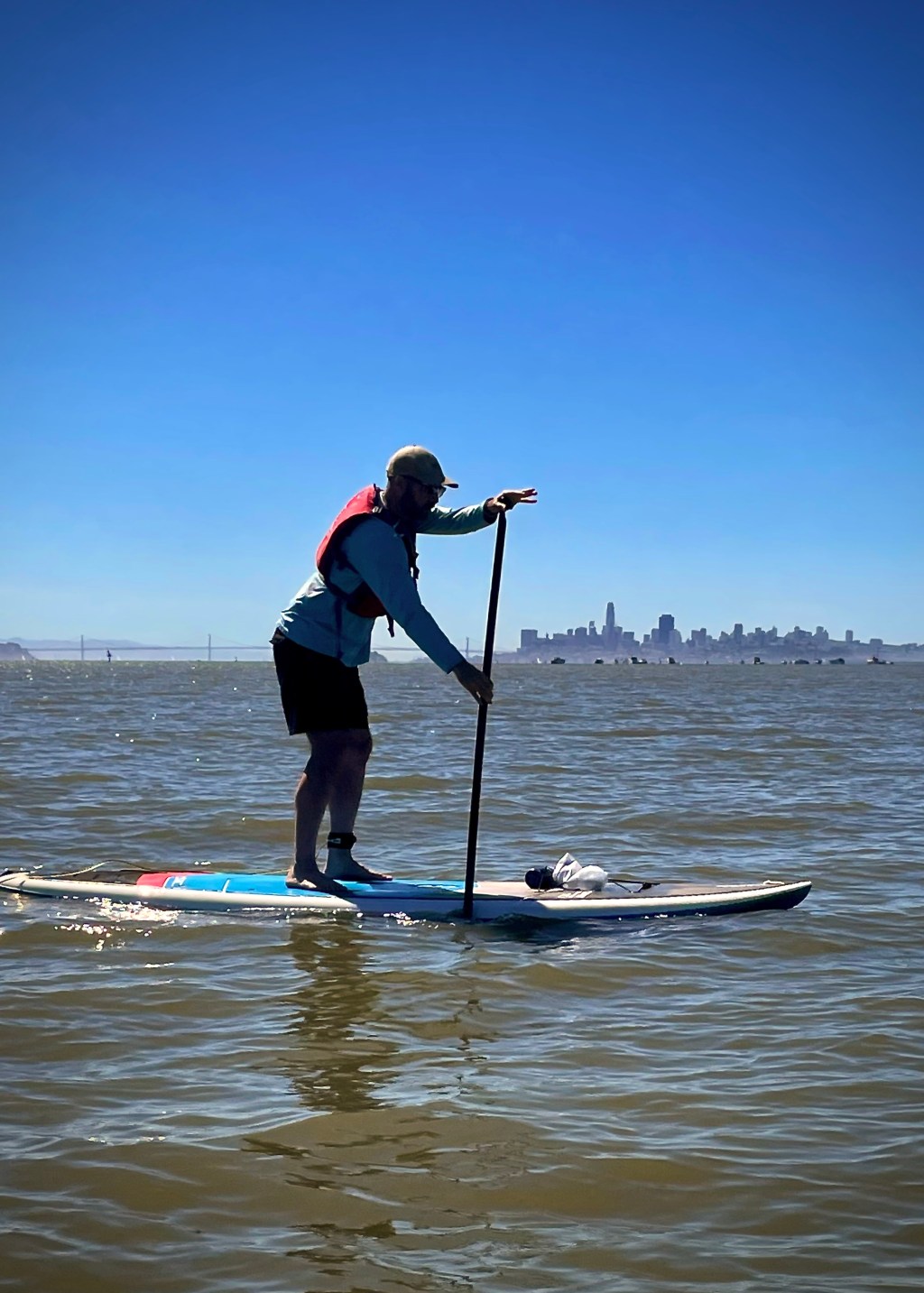
I finally tried it.
It was the early 2000s when I first saw people on standup paddle boards.
I was in North Shore, Calif., near the Salton Sea when I saw the boarders on the water near the defunct North Shore Beach and Yacht Club.
They caught my eye because when it came to human-powered water sports I was much more used to seeing kayaks.
Even at first glance paddle boarding looked like a great combination of serenity and exercise.
Years later when I was in the Reno-Tahoe area and covering outdoor recreation SUPing had become big business and people were taking boards on river trips or hauling inflatable boards into the mountains to paddle on alpine lakes.

Yet it remained on my list of “someday I’m going to try that” activities.
Until recently.
A nice guy named Noel who I’d met during a rock climbing course invited me to join him to try it out.
He’d been gifted credits to use at Sea Trek, a kayak and paddle board rental business in Sausalito, Calif., and also wanted to try SUPing.
I jumped at the chance and was glad I did.
We met at Sea Trek around 9 a.m. on a Saturday. Sea Trek allows patrons to register and sign waivers online in advance so all we had to do was walk up to the counter, sign in, grab some life jackets and dry bags and head down to the pier.
From there workers sized us for paddles and pointed us to a couple of boards that were already in the water.
After about 30 seconds of instruction we crawled, rather than stepped, onto the boards.
They urge guests to crawl, not step, onto the boards to reduce the risk of tipping the board one way or the other and falling off.
Once kneeling on the center of the board you can paddle away from the dock and then stand. That way, if you fall you’re in no danger of striking your head or neck on the dock.
I paddled from a kneeling position for probably 100 to 200 feet before standing. It was wobbly at first but I was able to stand well enough to paddle out onto Richardson Bay toward Belvedere Island.

To be honest, it was pretty straightforward. You keep your center mass at the middle of the board and use the paddle to move.
After about the first 20 to 30 minutes I felt more confident on the board, but the arches of my feet began to cramp.
I went back to kneeling for about 15 minutes or so, which actually made for faster paddling. But eventually I stood up and felt more comfortable with my stance and the movements and my feet didn’t cramp up again.
It was a warm, calm day on the Bay so waves were minimal. And since it was morning boat traffic was light.
The boards were a great vantage point to see the San Francisco skyline, the marinas of Sausalito and shorelines of Tiburon, Belvedere and Angel Island.
If I had one complaint, it would be the difficulty of carrying items on board. I didn’t have any safe way to carry a camera and the dry bag containing my cell phone and wallet was a bit cumbersome to access. Also, the inside of the dry bag was incredibly hot after some time in the sun. My phone worked for a couple photos but I’d imagine it was pretty close to overheating and shutting down.
By the time we were returning to Sea Trek a couple hours later both the winds and the number of boats on the water was picking up.
It was a great way to spend time on water and I’m convinced I’ll be doing it again soon. I’ll do some research on inflatable versus hard boards and new versus used and, hopefully, find something suitable for my skill level and budget.
Once I land a board I’ll look into good ways to safely carry a camera on it.
It’s not that complicated to learn. I’d say the most important thing for me, as a beginner, was being comfortable moving between standing and kneeling positions while out on the water.
Then again, it’s almost easier to paddle while kneeling so, despite the word standup in the name, there’s no reason you couldn’t kneel the entire time if that felt more comfortable.
I’m grateful for the people at Sea Trek for being friendly and knowledgeable and grateful to Noel for letting me tag along on the adventure.
 Occidental on Purpose
Leave a comment